Does food in the building actually move employee satisfaction?
By Hayden8 min read
Do office vending machines improve employee satisfaction? The honest answer: the machine doesn’t — the food access does, and the data behind that is stronger than most perks can claim. Workplace food surveys put convenient, subsidized or on-site food at the top of what employees say they value, ahead of far more expensive benefits. Here’s what the numbers actually show, why it works, and how a Vancouver office gets the upside without the sad machine-by-the-service-elevator part.
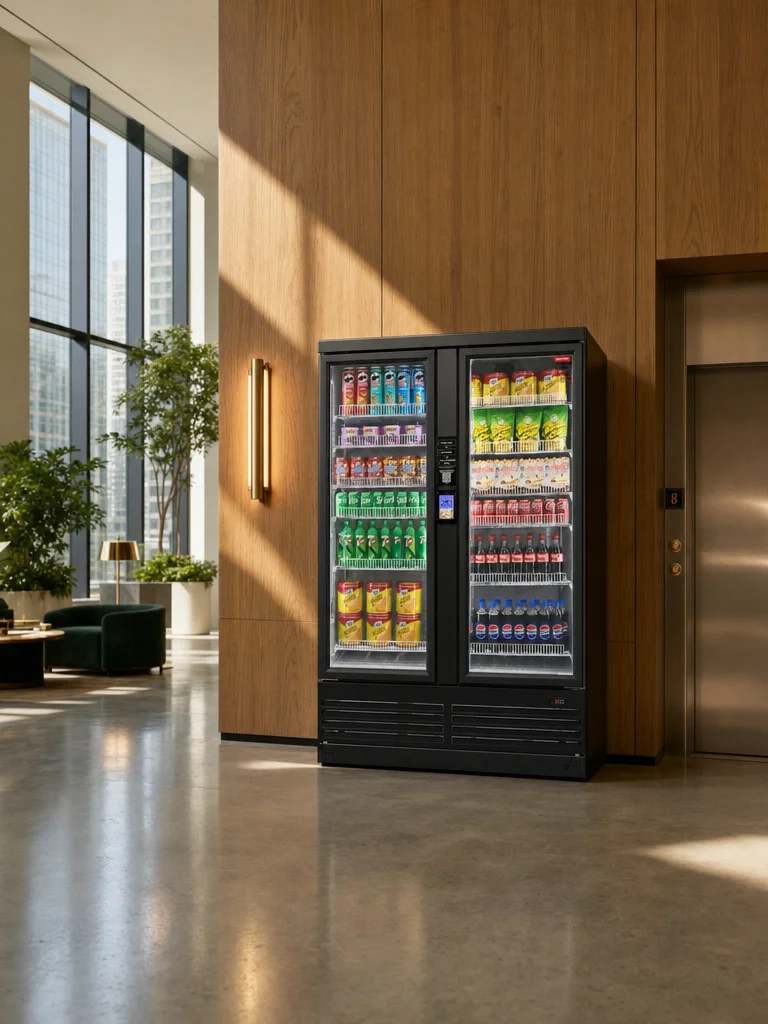
The short answer
Food is a daily-frequency perk. A wellness stipend gets used monthly; an education budget, maybe twice a year. Something cold and decent within a one-minute walk gets used every single workday, which is why it consistently outperforms costlier benefits in employee surveys. For the employer, the placement model makes it the rare perk with no budget line: an operator like Tidewater installs and runs a smart cooler or micro market at zero cost to the host.
What the surveys say
The most-cited dataset is ezCater’s Food for Work report, which surveyed employees whose companies provide food at work:
- 57% named free or subsidized food the perk they appreciate most — ahead of flexible work arrangements, wellness and education stipends, and even profit sharing.
- 50% said food at work would make them more likely to accept a job offer.
- 46% said it makes them more likely to stay with their employer.
The format side of the industry tells the same story from the other direction. The trade publication Vending Market Watch’s 2026 state-of-the-industry report found the convenience-services sector passed US$40 billion, with AI-camera smart coolers now a third of newly deployed equipment — workplaces aren’t just adding food, they’re replacing the old format wholesale. One caveat we flag every time: most of this research is US-derived. Canadian workplaces differ in the details, though tap-first payment habits here actually favour the newer formats — contactless already carries the majority of Canadian transactions, per Payments Canada.
Why food access moves the needle
Three mechanisms show up over and over in workplace research, and they’re all mundane in the best way:
- It erases a daily friction. The 3 pm leave-the-building coffee-and-snack run costs 15–25 minutes. On-site grab-and-go turns that into ninety seconds — repeated across a team, every day.
- It reads as care. Employees interpret decent food in the building as the employer thinking about their day-to-day, which is precisely the feeling engagement surveys try to measure.
- It anchors the return-to-office bargain. For hybrid teams, the office has to out-compete a kitchen at home. Amenities people can taste are the easiest wins on that list.
None of this requires a chef or a cafeteria budget. It requires cold drinks and real food, reliably stocked, within a short walk.
The old-machine problem
Here’s the catch in the data: the perk only pays off when the experience is good. A dated coil machine that eats a toonie, hangs a bag of chips against the glass, and offers the same lineup it did in 2009 doesn’t signal care — it signals the opposite. That’s the gap the newer formats close. A smart cooler opens like a fridge after a tap, lets people read labels and change their minds, charges automatically for what leaves the shelf, and reports its own inventory so restocking happens before favourites run out. We wrote a full comparison in smart coolers vs. vending machines if you want the mechanics.
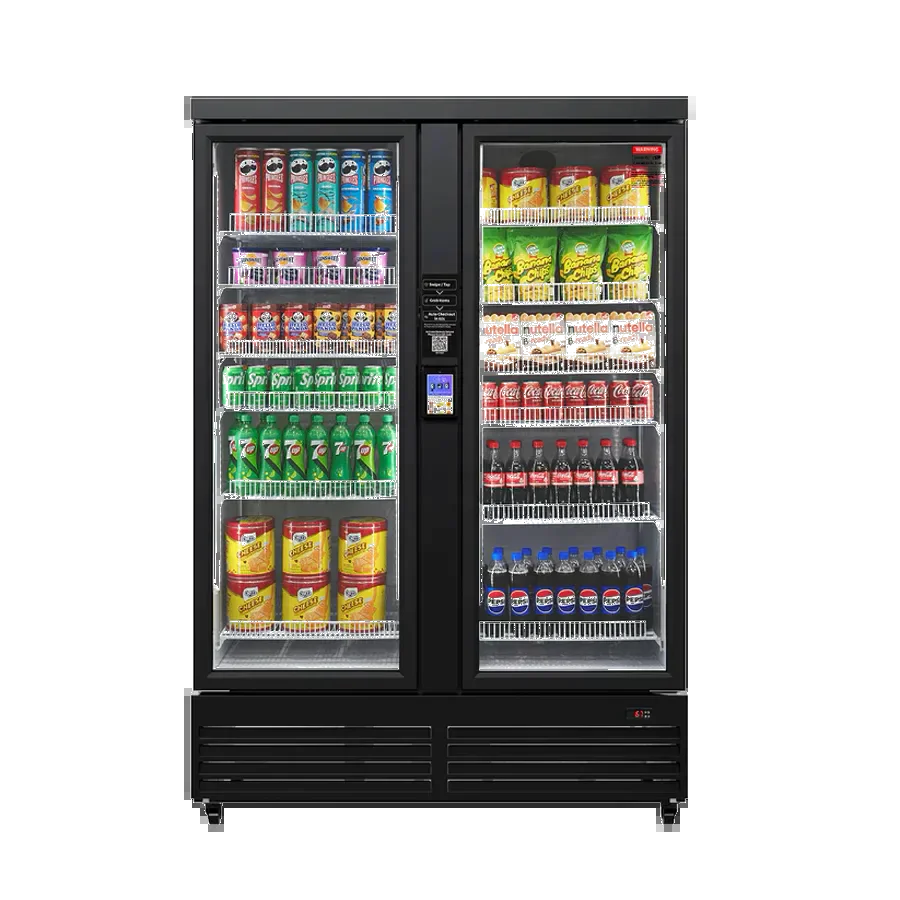
What a good setup looks like
From placing and servicing these across Metro Vancouver workplaces, the pattern that earns daily use looks like this:
- Placement people pass anyway — break room, amenity floor, or lobby, not a basement corridor.
- An assortment that matches the team — sparkling water, cold brew and protein alongside the treats, tuned by what actually sells.
- Tap-only payment — Interac, credit, Apple Pay, Google Pay. Nobody carries coins to work.
- Someone else running it — stocking, cleaning, refunds and repairs belong to the operator, not to whoever in People & Culture drew the short straw.
The walkthrough of the shopper side lives on our how it works page; the office-specific details are on smart stores for offices.
What it costs an employer: nothing
This is the part that surprises office managers most. In the standard placement model, the operator owns the equipment, pays for stock and service, and earns from sales — the host contributes an outlet and the floor space of a fridge or two. Tidewater places, stocks and services every unit we operate, free, with an optional commission back to the host. The full model is laid out honestly in how free placement actually works. The practical threshold is roughly 50+ people through the space daily; a fifteen-minute site walk confirms fit either way.
FAQ
Do vending machines really improve employee satisfaction?
The food itself does. Surveys consistently rank workplace food among the most appreciated perks — ahead of wellness stipends and education budgets. A vending machine is just one delivery mechanism, and the dated coil-and-drop kind can undercut the benefit; a well-stocked smart cooler or micro market delivers it without the frustrations.
What should an office stock to make people actually use it?
Variety beats volume: real drinks beyond soda (sparkling water, kombucha, cold brew), protein options, and a rotation that responds to what sells. Smart coolers report live sales data, so the assortment adapts to your team instead of staying frozen at chips-and-chocolate.
How much does it cost a company to get a vending machine or smart cooler?
In the standard placement model, nothing. The operator owns, installs, stocks and services the equipment and earns from sales. Tidewater places smart coolers and snack stores in Metro Vancouver workplaces free, with an optional commission for the host.
Does our office have enough people to qualify?
Around 50 or more people through the space daily is the usual threshold for a dedicated smart cooler. Smaller teams can work when the building shares an amenity floor or lobby — a quick site walk settles it.
Is workplace food worth it for hybrid offices?
Especially there. When people commute in only some days, small in-office comforts carry more weight in whether the trip feels worth it. Grab-and-go food is one of the cheapest levers a workplace has — for the host, literally free.